Sunday, May 25, 2014

Home visit and Cappadocia

After lunch we continued north through the mountains to the village of Ormana, known for its stone homes.  We were met by our home visit host, Hatice, who led us on a stroll around the village.  Past the old stone homes, the school, park, restaurant and coffee house.  Several people stopped to talk and we were treated to warm out of the oven bread at the beautiful new local restaurant and enjoyed tea with the gentleman of the village outside the coffeehouse.  

Most of the residents are farmers and herders.  In the summer they take their cows to the a higher valley where they roam.  The land is full of fruit trees and fertile gardens.  We asked about their farms and they have been in the family for generations though the younger generation often heads to the city for school and work.  At least one of the children will remain in the village to continue the family business.  We met the butcher and an electrician.  Great fun.  

The house we stayed in is two years old and built to accommodate family who return in the summer from the city.  That meant there was plenty of room for us on the second level of the house.  A delicious dinner cemented our belief that home cooked meals are the best.  Eggplant, rice, bread, salads and soup.  The traditional menu but so much better when cooked at home.  Our hosts ate with us and answered questions about their garden and cows.  We also talked about their daughter who is in Istanbul studying to be a mathematics professor.  After dinner, Hatice, showed us the work of the village women who meet in the school on the weekends to weave.  Hatice also knits and crochets borders on scarves.  We had great fun learning how to tie scarves so they stay on your head—Boo and Nancy were the models.  Hatice is a very strong woman, also gorgeous, who balances tradition and contemporary life with seeming grace. She clearly runs the house, not the stereotype of an Islamic woman.  She and her husband were not part of an arranged marriage, but their marriage was approved by the family.  We were all delighted to be in her company.

Up in the morning to head out again.  We stopped in Konya the visit the Mevlana museum to learn about the mystical Sufi order of Mevlevi, or Whirling Dervishes.  This sect was founded by Mevlana Calaleddin Rumi—the 13th century poet who is the best selling poet in the US.  The doctrine advocates unlimited tolerance, positive reasoning, charity and awareness through love.  


He treated members of all religions equally.  The museum houses the marble tombs of the Dervish abbots and was breathtaking. Unfortunately we could not take photos, the main part of the temple was intricate and colorful in its decoration.  

The tombs were decorated with embroidered cloth and a dervish turban indicating their rank.  The main section was expanded over the years to include rooms for those studying to be Dervishes and included community rooms and a kitchen as well as an expanded mosque.  The museum, housed in the rooms depicts life and artifacts of the time of Rumi.


Along the way we also stopped at the Sultan Hami, a caravan stop of the Silk Road. It reminded us places in Uzbekistan, the caravan hotels often built beside a mosque and madrassah. Here behind the outer wall of the Sultan Hami there is a small mosque, areas for repairs, sleeping, bathing and financial exchange.


Tulay, our guide, finds discoveries every day.  Today’s was the 1000 year old Chestnut tree. Other days discoveries included back allies in Istanbul, the funicular, the Apollo temple, the waterfalls for lunch and many more.  We appreciated her knowledge of history, people, cultures and places.  In addition she is a great at identifying trees, plants, flowers, and herbs.  On occasion we would stump her with a question, but it was rare, and her comment would be, “that’s a really good question for which I have no answer.”  That would make us smile and we would continue on our way.  She shared the politics of Turkey, past and present and told us about the influx of Syrian refugees, well over a million, with the local municipalities all trying to help with housing, food and clothing.  
Every town center has a statue of Ataturk, the father of Turkey’s independence and first President of the republic which he formed into a modern secular democratic nation/state.  Thousands of schools were built.  Primary education was free and compulsory and can you believe women were given equal political and civil rights all before he died.  Although he died in 1938, he is loved throughout the country to this day.  After driving in Uzbekistan we were extremely appreciative of the highway system here, good roads connecting all parts of the country.

Cappadocia—holy smokes, there are not enough words to describe all that we experienced and saw in our two very full days here.  We started by checking into our hotel, the Alfina Cave Hotel, which as the name says, is cave like rooms carved into the lava rock of the hillside.  The rooms were quoted beautiful and contemporary, who would have guessed a cave could be so comfortable.  Our first view of the landscape and fairy chimneys (think a relative of the hoo-doos of Bryce Canyon in Utah) were nothing compared to what we would see from the balloon and on tour tomorrow.  We drove through a town to a hight point where we could take pictures of the carved homes built into the hillside.

Cappadocia is an area of Turkey, not one city, it is known for it’s unique moon like landscape, underground houses and churches carved into the rocks.  Early—and we mean early, the next morning, we were picked up at 4:10 am to start our balloon adventure.  It is quite cool in the night/early morning so we dressed in layers—after breakfast, Boo, mother Boo, Nancy and Sue found ourselves at a sight with balloons prepping everywhere and taking off in the first light.  

We climbed, less than gracefully, into the basket which holds 20 passengers, our pilot Mustafa introduced us the ride, the landing position and his plans for the journey—catch the wind and see as much as possible.  This was Nancy’s first balloon ride and after a few jitters all was well.  Once up, everywhere we looked there were balloons and fairy chimneys, carved homes, farm lands, mushrooms like rock domes and the nearest spread out below with soon to be blue skies.  For the next hour we lived in paradise and floated over the different landscapes formed by the lava flows and erosions of the area.  Unbelievable.  As we descended the trailer for the basket came near to us and Sue jokingly said, “put on the trailer.”  And he did!!  He said we would have landing, so no special landing position and we landed standing up on the trailer to much applause.  Champagne followed and the basket was decorated with flowers for the occasion.  WOW!!


Back to the hotel for another breakfast and meeting time of 9:00 am to “begin” the tour day.  Our first stop was the Groeme open air museum.  It is from the fourth century and the first sign of monastic activity is the area is found here.  3-4 churches, dwellings, and a monastery are housed in this small valley.  The walls are decorated with Byzantine art.  The communal dining hall was one huge slab table with benches carved out around it.  The entire space was carved from the rock.   


We drove through the valley to another village for lunch and a school visit.  Our meal was cooked in tall clay pots with narrow openings which were topped with bread.  To serve, the top of the pot is broken off and the hot meat casserole is poured into a hot skillet on the table.  It is traditional dish, but the tops are only broken off for show in restaurants.  It was good.

We arrived at a middle school and were greeted by the principal and the english teacher.  The english class was taking a test so we stood in the lobby and on the front stoop interacting with kids at recess and for 7 minutes between classes when they go outside to visit and run around.  “hello, how are you, my name is, how old are you” were the favorite topics of conversation.  We went up to the english classroom and were greeted by noisy middle schoolers.  They are the same everywhere, much to our delight.  We sat with students at their desks and had conversations as best we could.  Sue’s girl’s asked about make-up.  Not exactly her area of expertise.  

One of her girls liked basketball.  Nancy’s liked swimming and reading.  Soon some girls entertained with songs—the macarena to the months of the year, and Roar by Katie Perry.  What a voice.  Sue and Nancy recruited Boo and we sang our standard, the hokey pokey.  Much fun was had by all.  We left gifts, books, markers, games and the hit with the teacher was the video we brought of Frozen.  Hopefully the kids will get to see it!  We said our good byes and went back to the hotel.  Naps were instantaneous.


In the early evening we went to a Dervish ritual of Sema. They believe that everything revolves, atoms, the earth, planets, and the stars.  And if you participate in whirling you are sharing in the universal revolution of all existence.  The ritual is spiritual journey of seven parts, with 4 instruments and singers who accompany the Dervishes as they complete the ritual including several segments of whirling.  Other segments include reverence to each other and the elders of the sect.   It was quite interesting and mystical.  Much to our surprise and the surprise of Tulay, they invited us to take pictures after the ritual was completed.  They even whirled for us for photos.  It was a very enjoyable evening.  In Egypt, we saw a Dervish entertainer, which was fascinating but very different from being able to observe the whirling in ritual practice.

Dinner by the river, our official farewell dinner, though not our last.  A beautiful view of the mosque at sunset reflected in the river.  This is a good time to say how much we enjoyed our fellow travelers.  Each was different but we fit together well as a group.  Sharing interests, need for rest, willingness to hike, love of shopping and photography.  We appreciated the great book references from Nancy and Pat. Al’s adventurous nature and willingness to help Nancy by finishing her desserts were welcome parts of the trip.  George and Dolly inspired us to keep traveling—at 90 and 86.  We loved their stories and sense of humor.  Boo made us laugh and kept Nancy going on hard hikes.  Mother Boo, aka Carolyn, shared her travel stories and sense of adventure.  We will miss everyone once we travel on our own in Istanbul.  We were grateful for excellent drivers throughout the trip and Tulay was just special.

Our last day:

We got to sleep in and left at about 9:00 to see the underground city. In order to protect this monastic way of life which was often threatened by the invading Arabs, residents created complete underground cities.  Rooms used for storage in ordinary times, led to 5-8 levels of rooms, churches, stables, wineries, ventilation and water systems, toilets and meeting rooms.  main tunnels were could be blocked by huge round stone slabs that rolled into place and were held by rock wedges.  When the rocks were removed the stone slab rolled back by gravity as the groove was slanted down.  They had communal cooking areas and stones for milling.  Some tunnels were kept purposely narrow and low so if enemies got in, they would have to stoop, go one at a time and could not use their weapons.  They would be met by the residents who could then chop off their head.  There are some forty cities that have been found so far with many more thought to be in existence.  We has a wonderful guide who has been working their for 48 years, since the original tours began.  A very gentle and interesting man.
Next stop was a workshop where we learned about the 9,000 year old pottery making tradition of Anatolia.  We watched a craftsman make a covered jar and then watched Boo try her hand at a bowl with fluted edges.  We learned about the one of a kind, freehand painting, numerous firings and final glaze.  The clay is white and the pottery tradition was for the families of the sultans.  One of the surprises here was a room—the showroom was built in caves—in which the pottery glowed in the dark.  Quite unique.

We drove though the valley again to various photo stops, a rock that looks like a camel, a hike up a small hill to see “mushroom towers” and off into the valley.  The area often reminds us of the Grand Canyon with its cliffs of reddish colors that change with light of the day.  Boo talked Nancy into another hike up a towering formation in the center of a village.  Rooms were dug out and people at one time lived there.  While no one is living here now, there are still formations that are currently inhabited and many are being turned into boutique hotels and restaurants.  The view from the top of the formation was stunning. Next was the optional hike into Baglidere Valley also known as Love Valley (the photos will show why).  

Al, Boo, Nancy, Sue and Carolyn decided to go, others were dropped at the hotel.  Worth the trip but we were pooped when we finished.  Tulay described it as up a little, down a little, she forgot the up a little more part. There we found fairy chimneys, a dried up stream, a man with a market where Nancy had fresh squeezed orange juice and we watched his fascinating pigeons fly, hover, flap their wings in such a way to make noise and then gently land.  
The gendarma roam the area on horseback to insure the safety of the area and its visitors.  They had two beautiful horses that we also watched for a wide. The area is also farmed and had several tiny vineyards.  It was a great walk.  Boo met a man, from another OAT trip who graduated college with her dad.  They talked for a while and he is anxious to go home and look in his yearbook to put a face to the name.  Who would have expected that in the middle of Turkey.


So ends the OAT, one last dinner at the hotel and a flight back to Istanbul. We did not get to sleep it, wake up call at 2:30 am.  Hugs and goodbyes at the Istanbul airport as we stayed and others went off to catch flights to the US.

Saturday, May 24, 2014

Trip on the gulet continues and Antalya

Day two on the Gulet. We moved in the morning to a scenic cove which shelters the sunken baths of Cleopatra built for her by Mark Antony.  Legend says that he gave her the entire Turquoise Coast as a wedding gift.  Today’s hike went up the “hill”, down a bit and up another “hill”. Sue choose to stay home on the Gulet.  At the top we visited a mountain home where we enjoyed visiting with the home owner.  His wife had hurt her back and had gone to the hospital via donkey, boat and bus—some two hours journey.  We bought bells on woven rope with goat hair tassels.  She does the weaving.  On to more ruins including cisterns which look like domes scattered around the hills.  The ruins were Greco-Roman  called Lydea.  The boat moved during the hike and met us in Friendship cove as we came down, down, down the other side.  Hard hike because of the loose rock but well worth it.

The prize at the end was a swim in the cove off the gulet.  Brrr.  To prove she wasn’t a total wimp, Sue jumped off the top of the steps, what a wedgie.  

We set sail, without motors, for the afternoon and enjoyed the glorious quiet and view, not much wind so we did not go very far.  Off to the next sheltered cove for the night.  When we set anchor the food appears.  Apo, the chef has a small kitchen and works wonders.  We loved the eggplant dish and rice.  Twice they grilled kabobs—delicious.  Too much food but we all wanted to take Apo home with us.  And oh yes, olives for breakfast.


Day three—We made a landing on a small beach in the bay of Gemiler and drove to the “ghost town”.  Up and down the hills, switch backs all the way.  The hike was in Kayakoy once inhabited by Anatolian Greeks. They lived on the hillside and were the craftsman of the area.  The turks lived in the valley and farmed.  It was a perfect arrangement and friendship among the residents.  During the 1920’s the entire Greek population was relocated to Greece in the aftermath of the Turkish War of Independence.  Turks living in Greece were relocated to the hillside.  The valley Turks missed their friends and continued to hope for their return.  The two groups of turks never messed and eventually the 600 hillside homes were abandoned.  

They are kept preserved now as a reminder of the friendship of the two nations.  It was fascinating site and Sue was especially proud of managing the hillside hike.  Patty convinced Nancy to go the highest point and after much huffing and puffing they and others made it to the top—what a view off both sides, into the valley and off to the blue waters.

Back to the boat for lunch and Dolly's 86th birthday party.  Apo made a delicious multi-layer cake.  Everyone thanked Dolly for having a birthday during the gullet portion of the trip.


Day four, disembarkation day.  We traveled overland from Fethiye to the resort town of Antalya.  The mountains grow out of the sea with the road hugging the hills.  Much like Route 1 in California, but the road is much closer to the water.  A few stops for pictures of the turquoise water and we arrive in Myra.  The Roman ruins here are quite interesting with it’s large theater and mask friezes scattered around.  It also features Lycian house tombs carved into the cliffs.  This was all built in the fourth century BC.  As with all ruins, there is an amphitheater.  Helenistic theater seats are built into the hill while Roman theaters have back walls to support the upper seats.Then off to Demre where we went to the Church of St Nicholas.  St Nick loved children and was known to give them gifts at every opportunity.  The church is full of beautiful frescoes featuring St Nick as well as other religious figures.  The statue  outside the church is dedicated to Children of Peace throughout the world.  St Nick was the model for the modern day Santa Claus, he is also a favorite saint of the Russians who come in masses to visit this site.

After a great lunch we are off to Antalya.  We are staying the in the old town which requires us to walk to the hotel, no busses allowed.  We stop at the harbor and wind through old streets with shops, restaurants and hotels.  Our hotel is quite charming and we enjoyed dinner on the patio.Much to our surprise along came a garbage truck, that was not the surprise, the surprise was that is sounded like an ice cream truck except that the tune playing was Vivaldi.  Go figure that one out.

In the morning we are off for a walk in another direction through old town to a set of gates in the city wall.  On the way we saw the ruins of a church turned mosque—they add minarets and often new arches.  Pointed arches are indicative of Islamic design.  The old city, like the balance of Turkey, is filled with beautiful flowers wherever we look.  This is also a good time to talk about the cats—everywhere we go, on every street, in every restaurant, in every ruin, in every store and just plain everywhere, there are cats.  All appear to be healthy and we fed our share.  The people of Turkey seem to love them and let them roam about.  Many leave food for “regulars” at spots around town.

Our goal for the morning is the Antalya Muzesi.  The museum is full of artifacts from the stone age to the present.  One room contains statues from one of the larger temple excavation sites.  They are beautifully sculpted and are of the gods from ancient mythology.  One of the early stone age pieces depicts an early full-bodied goddess.  Quite amazing.  


The afternoon was time on our own.  So Sue decided, when in Turkey, take a Turkish bath.  She went with Patty, nicknamed Boo and her mother Carolyn, or Mother Boo, to a local traditional bath house which was at least 100’s of years old.  Women on the left, men on the right. You quickly loose any modesty you had when they take you to a large domed room made of marble where you sit buck naked and pour hot water over yourself for 1/2 hour to 45 minutes.  Then one by one they went into another room to lie on a huge marble slab and your entire body, except head, is buffed with a sand paper type mitt by a Turkish woman.  Then once again you pour water over yourself to wash away the dead skin and get back on the slab.  Next thing you know, you are covered in bubbles.  They are hard to describe but feel like you are floating in effervescent bliss.  Then more water over yourself and wash your hard, wrap in a towel and off to a room to be oiled and gently massaged.  Heaven, I’m in heaven.

That evening after a short walk and dinner on the patio we packed for our next day’s journey which included a home stay.  We drove to Lake Beysehir and into the Taurus mountains.  The mountains are quite spectacular and the topography changed as we rose in elevation.  We stopped for lunch at another ruin and walked down to the seaside through a road that reminded Nancy and many seaside resort towns.  Rounding the corner we were greeted by the remains of Apollo’s Temple.  Today’s discovery.  We went off to have lunch by the waterfall and enjoyed the kabobs, cats, baby ducks and all the little kids they attracted.

Friday, May 23, 2014

Ephesus and on to Gulet (day 1)

Ephesus and on to the Gulet

My goodness.  This is quite the amazing reconstructed ruin of an ancient city.  It is actually the third city of Ephesus and they moved for a variety of reasons.  First to the second city to be closer to the temple of Artemis, then away from the harbor as it filled with silt and became muddy, then to the top of the mountain as the Islamist moved in. The baths, gymnasiums, brothels, temples, statues, main streets and shops, fountains, theaters, pipes and gutters for water, the public toilet, homes and the library are built on the hillside above what was once the harbor.  Looking down the hill to the library reminded us briefly of Petra.  We did not get to go into the terraced houses of the rich residents this time, but may be back with our cruise.  One fellow passengers described Ephesus this way:  Carolyn—It was historically breathtaking, not anything like I thought it would be, it was much larger and grander.


We had lunch in the fourth city, on top of the hill.  It used to a Greek town but at some point the Greeks went to Greece and Turks living in Greece came here.  It is an idyllic town up a narrow cobblestone road.  At the top the view of the red roof tops and the minaret in a heavily treed valley with beautiful little cottages couldn’t help but make you want to move here.  We had lunch in a garden cafe.  Did we tell you about the Turkish cats?  They are everywhere and people feed them where ever they are, in the subway, under the cafe table, in Ephesus….Sue fed the cat in the cafe.  A bite for Sue, a bite for the cat.
After lunch we wandered down through the town streets/market, shopping all the way.  You name it, they had it.  Including ice cream frozen in a at least a 10 gallon block hanging from a hook.  With a meat cleaver they shaved the ice cream to put into cones, usually curling the slice.  Fun.  We bought a few little things and admired all the purchases of our fellow travelers.

Off to St. John’s church at the top of another hill near Ephesus.  Once again ruins of a Christian church and the fourth city of Ephesus.  The ruins were filled with flowers of every color and type.  We find ourselves drawn to the flowers over and over again in Turkey.  The roses are stunning and grow everywhere.  Some are cut back and some are twenty feet tall.

Back to the hotel, built on the hillside over the ocean in Kusadasi.  It is an older hotel with blue couches and walls, a classic old bar, an African Grey bird in the lobby, with a resident dog and a few stray cats roaming in and out.  Walls have pictures of the rich and famous from days gone by, including Her Royal Majesty.  We did not see Hilary. Floor to ceiling windows in the dining room allowed us to view the Mediterranean sunsets.

In the morning we left to start our trip towards the Gulet.  Who could have believed that we would spend 4 hours at a rug weaving workshop, school and wholesaler, not to mention the restaurant on the side with it’s own winery and olive orchard.  It is a cooperative in the truest sense of the word, trying desperately to keep the traditional handicraft of rugs making alive.  The buildings were originally the dormitories for the rail road workers.  We had demonstrations on weaving, dying and our favorite—catching the threads of the cocoons by using a whisk type broom.  First factoid:  one cocoon can produce a thread a mile long.  Next came the carpet demonstration from traditional nomadic wool carpets to fine silk art pieces with up to 4000 knots per square inch—at $50,000.  We succumbed.  We bought a nomadic rug made by a young woman prior to being married, you can tell by the way the fringe knots are tied together.

We had delightful barbecue chicken and lamb lunch in the garden next to olive orchard.  Five of us bought rugs, so we were all happy.  Each meal comes with yogurt, tomato and onion salads, bread, and olives as starters.  Nancy shocked Sue and tried an olive, she still doesn’t like them.  Turks love them and eat them with breakfast as well.  So does Sue.  Their rice is scrumptious.  Tulay says it is cooked with butter, no wonder we like it, but there is more to it than that.

Onward to the town where we get on the Gulet, last minute shopping for sunscreen, sunglasses, pharmacy items and changing money.  Off we go.  We are welcomed aboard our double masted ship that has 9 or 10 cabins.  A crew of four, captain, cook, first and second mates.  We motored not far to our night moorage in a bay.  Dinner was served on the back deck.  Chicken and great rice!  With the normal starters and fresh fruit for desert.  Our cabin has two beds, one an upper bunk, and two port holes.  Also its own bathroom with shower and another porthole.  Sue liked describing gullets as looking like Captain Hooks boat, but in reality they are large wooden vessels complete with small bar, galley and plenty of space for everyone.

We lifted anchor at 5:30 am to head to the rendezvous with a smaller river craft.  We travelled through the reeds of the river basin past a beach where the logger head turtles come to lay there eggs.  It is just the start of the season and the third turtle came up last night and left its trail in the sand.  We stopped at a spot where they were catching blue crabs.  They took small ones and tried to attract the turtles for us to see.  Success.  On to our docking spot where we began our walk up the hill to another city in ruins.  There are few beaches here as most of the rock and trees come right down to the ocean.  We found a theater, main street, argos (the market place), church, harbor and city wall and fortress on the mountain side.  The alter in the church still exists from 5th century AD.  Wall carvings of crosses where on the floor, but intact.  Goats, sheep, tortoises and donkeys, including a pregnant donkey hiding in the bushes, roamed the ruins and posed for many a picture.  Again flowers everywhere, thistle, orchid, pomegranate, limes and poppies filled the landscape as we walked down the other side of the hill to the waiting boat.  Up river we viewed the burial site carved into the rock cliffs.  They look like old roman buildings complete with pillars.  The largest, for the king was incomplete but you would see the cave below where he is believed to have been buried.  There is little flat land for cultivation so the town, homes and burial sites are all on the steep hillsides. 


Lunch on the boat.  Patty and Nancy (not Desmond) jumped in for a cold swim.  Waters are promised to be warmer tomorrow.  A nap on the front deck cushions as we cruise to our next moorage on a beautiful sunny yet hazy day through the islands on the coast.


Saturday, May 10, 2014

Turkey day 1-4

We arrived, got through customs much more quickly than last time, after a five hour flight.  Went to the hotel in the old city which is on the European side.  Istanbul is the only city that straddles two continents, Europe and Asia.  The European side holds the old city and the financial district.  The Asian side tends to be residential. They are separated by a body of water each side lined with beautiful old and new homes, clubs, hotels, restaurants and resorts.

We ventured out to walk in the neighborhood a bit and changed money, ate at the cafe in the hotel and called it a night.

Morning brought introductions to the new group members, Al, Patty aka Boo and Carolyn.  We began the tour of the city at the Blue Mosque, named for its shimmering blue tiles that line the interior.  It is an example of Ottoman Architecture built from 1609-1616.  It has six minarets which is unusual and were created by the architect to make this a unique mosque and thus one of the defining elements of the Istanbul skyline.

The Topkapi palace was built beginning in 1459 and was the royal palace of the Ottoman Sultans until 1853.  It is one of the richest museums in the world—think crown jewels multiplied, including an 86 carat diamond, box of emeralds the size of easter eggs and rubies everywhere.  It is a large complex and it took us several hours to just get a taste of it grandeur.  The tile work and museum collections are magnificent.


Off to the grand bazaar—with explicit instructions about how not to get lost.  3600 shops and 58 streets in a covered bazaar which is one of the largest under one roof.  You can purchase anything from fine jewelry to trinkets, antiques to pottery.  One could spend a lifetime just looking, we will be back here during our five days in Istanbul later in the trip.  We found a little cafe at junction of five streets where we and enjoyed people watching.

Before dinner we took a cruise on the waterway to see both sides of Istanbul.  It was cold, cloudy and windy but enjoyable never the less.  

We had dinner at an old soup kitchen, now restaurant, which is part a lovely mosque compound.  We drove home under the roman aqueduct to retire for the day.

Morning rains, but it did not stop us.  Back to the old city which is full of stunning palaces, mosques and other building bearing the mark of the Ottoman period. First stop Hagia Sophia, the “Church of Divine Wisdom” built in 537 AD.  It is an absolute wonder.  The dome takes your breath away.  This massive building was a Christian church for 1000 years until it was claimed as an Islamic Mosque.  In 1934, the founder of the new republic proclaimed it as a museum.  The tile work is nothing short of phenomenal, with representations of Christ, Mary, Joseph, and the arc angels.  Touches of Islam exist in writings in the stained glass and large medallions hung on the walls. There was a calligraphy exhibit of modern day artists that was stunning.  We know we are using a lot of adjectives and are running out of them but we could have spent days looking through this museum.  

Turkish Delight
Off to the spice market—and the rains keep coming. Colorful, and full of wonderful smells. You can find Turkish Delight candies and nuts of all kinds. We learned that Turks love sweets.  We indulged.  

Lunch and then crossing over one of the three bridges to take the oldest subway in the world, aka funicular in a tunnel, up to the top of the hill.  This is art nouveau part of town with little ally ways, trendy shops and small bazaars.  It is also the home of many consulates in renovated old palaces.  We stopped at several churches and went in an Armenian church with was very peaceful.  The alter was engulfed in a stunning deep blue glass dome of light.  Quite the sight.  The rains were now torrential with water running everywhere.  Soaked to the bone it was time to go back to the hotel.  


Dinner was in a small local bazaar of which the highlights were the bread, and the Turkish hats they brought for us to wear.  Early night before an early morning flight is Izmir on the way to Kusadasi.  Today’s highlight was a home hosted lunch in a village of approximately 300 farmers.  We were divided into two groups for lunch, one hosted by Grandma and Grandpa, the other by daughter and son-in-law.  The food was traditional with rolled grape leaves, stuffed green peppers, cheese rolls, pickled beets, delicious lentil soup, a yogurt eggplant salad and fresh bread.  Then came the main course of eggplant with minced meat stuffing and bulgar.  We all voted that the restaurants are ok, the home cooked meals are wonderful.  Desert was made by the fifteen year old son who is studying to be a chef, poppyseed cake and milk pudding.  Turks love their milk puddings in all varieties.  We gathered in Grandpa’s house to have tea and conversation.  The village administrator joined us and with Grandpa’s english and our guide we were able to discuss the village and politics, weddings, matchmaking and farming with lots of laughter.  The 6 year old grandson took great pleasure in presenting evil eye keychains to each of us.  We past the village center with mosque, coffee house and villages office before heading to Kusadasi, a popular seaside town, for the next two nights.  We are tucked in for the night and off to Ephesus tomorrow.


Friday, May 9, 2014

Samarkand

Samarkand is rich with the history of Amir Timur also known as Tamerlane.  He was born just south of Samarkand in 1336 and grew to conquer more territory than anyone else except for Alexander.  His armies crossed Eurasia from Delhi to Moscow and from Central Asia to Anatolia.  He was the last of the great nomadic leaders and has 27 states under his rule.  This was a golden age for intellects and artisans who gathered in Samarkand from all over the empire.
After one of his campaigns in India, he brought back elephants to Samarkand to help in the building of mosques, tombs and palaces. He believed in uniting the best from each place conquered.  

Our first stop was a Tamerlane family mausoleum, positioned in the shadow of a spiritual mentor so that his positive energy would continue to flow to the deceased.  This masterpiece of Islamic  architecture, built for one of Tamerlane’s grandsons, would be the inspiration for the Taj Mahal.  Then we visited the fifteenth century Ulug-bek observatory, built by the Astronomer, Sultan, and grandson of Tamerlane, Ulug-bek who ruled for 40 years and never fought a war.  He cataloged the stars and mapped out the sun, moon and planets.  He also wrote a book that is still used and referred to today.  He calculated the length of a year to within 3 degrees of what we use today.  It was Nancy’s turn to talk with local women who were visiting from another province.  They chatted as best they could and posed for pictures with Nancy.  Whenever we tell people we are from the US, they would say America with big grins.  We don’t think we have ever travelled anywhere where we have been approached so often or felt we could approach the locals so easily as here in Uzbekistan.

Next day we explored more of Samarkand.  The city was established in the middle of the first century BC and was an important stop on the silk road.  Did we mention that our trip is based on the cities and history of the silk road.  We went to a mosque, near the bazaar.  Our trip trough the Siab bazaar began at the sweets and bread aisles and moved out from there. People were everywhere but this was one of the cleanest and friendliest and most orderly bazaars we have ever seen.  Next stop, carpet workshop…


Most impressive buildings of the day were part of the Shah-i-Zinda necropolis of churches, temples and mausoleums built up the hillside.  The prophet Muhammed’s cousin is buried here as well as spiritual leaders, architects, military leaders and royal family members.  It was breathtaking.  We climbed 40 stairs and entered through an archway to a series of towering vibrant blues, purples and white painted and carved tile buildings.  The people watching was as important to the experience as the building themselves.  Building were added to the area beginning in the 11th century and continued through the 19th.  There are three groups of structures connected by domed arched passages.


Lunch.  Today we got to meet Abdu’s family.  We had lunch in his neighborhood at a friends home and his wife and two daughters joined us.  The young lady of the house (15) prepared the salads and starters with her grandmother who also made the soup.  Abdu’s wife cooked the delicious dumplings and this quickly became our favorite meal.  The girl’s were shy but it was long before Sue and another traveler had them singing ABC’s and Twinkle, twinkle…We scared them with the Hokey, Pokey.  We back to eating and let the girl’s go back to playing.


 Off the the bread maker.  This bread maker is a woman who bakes 50-100 loaves a day, beginning at 4 a.m., and sells them to restaurants in a nearby town where her husband is a chef.  She began learning at the age of 12, begging her parents to let her back with her grandparents.  She started the wood fire and then took us inside to learn how to shape the loaves.  After making the dough, she lets it rise for two hours, shapes and lets it rise again for two hours, thus the early morning start.  Our loaves would have to rise before cooking so she had other loaves ready to bake.  The bread oven shaped like a small igloo and made of clay bricks is situated in her courtyard.  Once the wood fire turns the the interior walls of the oven white, the bread is individually stuck on the walls and ceiling of the oven to bake.  Salt water speed on the bottom of the bread helps to hold it in place.  It was quite amazing.  The prized loaf is on the center ceiling, where it browns evenly.  15 minutes cooking time and it was removed to find 7 willing samplers.  They dip the hot bread in water which struck us funny but tasted good.  So here is it bread and water, literally.  What a delightful time we had!


Last day in Samarkand took us on a three hour drive to 
Shakhrisabze, the birthplace of Tamerlane.  We found a statue and remnants of a grand palace he built during his lifetime.  We visited the tomb where he wanted to be buried, in the shadow of his father and a spiritual leader.  We went to a mosque that was, to quote Sue, “really pretty” inside.  We drove three hours back. DInner—hmmm, hmmm chicken.  Roast chicken and the best bread we have had so far.  A local place Abdu picked out since we were all craving a lighter meal.  It was finger lickin’ good.  Unfortunately, the next day brought a 5 hour trip back to Tashkent.   The good news of the day was that Nancy, fellow passenger from Memphis, finally got her luggage--what a great sport she was about not having it for many, many days.


On the way back to Tashkent, we stopped at a mountain pass which was said to have been created to allow troops to pass through and defend the area.  The area is called the gates of Timur.    We observed the bullet train passing.  We saw the inscriptions on the wall that told of the opening of the gates.  The scenery was varied from desert to mountains, from sheep to cattle to donkeys.  One of Sue's favorite sights was of a gas station where the sole "vehicle" pulled up at the pump was a donkey and its elderly rider....On an earlier part of the trip we saw fields of poppies, rich red carpets moving in the wind.  

Our final afternoon in Tashkent and Uzbekistan we had some free time so went back to the street market called "Broadway".  Nancy found a red star pin given to children who did well in school during soviet times.  Sue found a fountain pen on a stand shaped like a rocket with a commemorative medallion from a 1959 Sputnik 3 launch.  We hoped to see the 400 year old Koran that an American UNICEF worker has recommended to us.  Upon arrival at the Islamic center we fell into conversation with students who studied there to become Imams.  They were curious as to our ages, Dolly at 86 and George at 90 always brings signs of respect.  They told us about their studies, their current work and the school itself.  By the time we got to the museum it was closed.  We went to the madrassah and did some final shopping before a delicious farewell dinner.  


Meet our traveling companions:  Nancy and Pat from Memphis, George and Dolly from New Jersey and Abdu.  We are now off to Turkey to meet a new guide and three new travelers.


Monday, May 5, 2014

Sunday in Samarkand

We made and arduous drive to Samarkand, for stretches, to say we were on a road would be an exaggeration.   The trip reminded us of Mongolia driving except that we drove slower and were in a vehicle with shock absorbers.  We also have an exceptional driver who went of his way to avoid the worst potholes and construction hazards.  We made one stop at a master ceramist workshop.  It seems like we are following in the footsteps of Hilary Clinton, because as with other stops, we always find her picture on the wall with the famous visitors.  We seem to be hitting the right spots.  The ceramics to be heavier, earthier and the glaze designs are specific to different regions of the country. 

Before we get to far into Samarkand, we should talk about our final evening in Bukhara.  We did attend the local dance, music and fashion show.  The traditional music and dance reminded us very much of Indonesia dances we saw recently.  The traditional costumes were ornate and quite lovely but was very striking were the contemporary fashions modeled by very thin young local women.  Lots of silk, vibrant colors, and flowing design.  Some of the pieces could be on the red carpet at the Oscars, they were just stunning.

We walked from the show on the square down several alley ways.  Homes are behind non-descript walls dotted with double doors which enter into the courtyards of each home.  We met our host and his family and were treated to a delightful dinner of Flov.  A traditional meal cooked by men over an open fire in a large wok like vessel.  They cook the meat in spices, add veggies, water and then rice.  Sounds simple but it takes quite a bit of time and is absolutely delicious.  It was our favorite meal to date.  All meals start with small plates of salads to be shared at the table, soup and then a meat course.  Homemade breads are a mainstay of each meal.  It seems that there are julienne style carrots, beets, cabbage and onions in every salad.  The soups are all different and each is wonderful.  From pumpkin, to mushroom, veggie, rice based, and chicken, they are all homemade and would be a filling meal in themselves.  Not only did our host cook us dinner, he shared his craft of embroidery with us.  He learned from his grandmother and is a master embroiderer with works hung in museums and commissioned from around the world.  He dyes his own silk threads using only natural dyes.  We would love to have one of his pieces but have to save up.  He teaches others the craft, including his children, and he gifted small pieces done by his family members on cotton.  Like Kilroy, Hilary was here too.


This is a good time to tell you about Uzbekke homes.  Almost all have a courtyard.  The youngest son’s responsibility is to care for his parents.  He and his family live on one side of the courtyard, his parents on another and other unmarried family members live there as well.  The women share the shopping and cook in a common kitchen.  Meals are shared in a common dining area.  Houses are all thick walled with tall ceilings to help with the heat and or cold weather.  Rugs cover the floors and shoes are removed before entering rooms.  The ultimate authority is the mother and father who make all the major decisions.  The customs of the country are built around respect for elders and their experience and knowledge.  It is quite impressive our guide, Abdu, speak with respect about his parents and others who are his senior.

On the drive we passed desert, farmland and small towns.  The government builds housing for farmers who get zero interest loans to buy their homes.  Primary crops are wheat, mulberry, cotton, fruits and veggies.  Uzbekistan is the fourth largest cotton producer in the world.  They also have lots of natural gas, oil and gold. Many of the factories and mining operations are done in cooperation with other countries.  


Samarkand is a city of 1/2 million people.  It is quite modern in a quaint kind of way.  We are staying on University Boulevard in the heart of the University.  It is tree lined with sculptures along the wide boulevard.  

Obviously more to follow we have three days in Samarkand to tell you about...If you did not check out the maps two posts ago, go check out where we are.  Also I was asked to make a correction, the earthquake was in 1966.

Friday, May 2, 2014

Uzbekistan

Day 2 in Bukhara and our guide is wondering why we have not written anything on our blog—he is keeping us too busy.

It was a long trip to Uzbekistan—MSP to Paris, Paris to Istanbul and Istanbul to Tashkent.  We had a 4 hour layover in Paris and about 6 hours in Istanbul with one hour was spent in the passport control line, 1/2 waiting for other passengers, 1 1/2 at a day room in a hotel, and 3 back at the airport to catch our midnight flight.  At some point we had done 10,000 plus steps on the pedometer and had not been out of an airport.  

The Boys
Tashkent is a big city full of Russian architecture.  The 1966 earthquake destroyed much of the city and the rebuilding was done with assistance from neighboring Soviet republics.  Builders were promised apartments if they came and helped to rebuild, the incentives worked and also created a diverse population.  The city is marked by wide boulevards, green spaces, squares and statues.  We were pleasantly surprised by the peaceful yet modern feel to the city.  We never did find a lot of traffic but noticed that 99% of the cars are white and many of those are Chevrolets, made in Uzbekistan.  After a delicious local lunch we walked back to our hotel via a road filled with street artists and vendors.

We visited the former “Red Square” that is now Independence square.  It has a war memorial, with a statue of the Sullen Mother,  a sixteen column entrance gate and an independence monument.  Uzbekistan became independent in 1991 so is still a young country despite it’s long history.  The other highlight of the morning was a visit to a madrasa where artisans come to study with master craftsmen—wood and metal carving, miniature paintings, and pottery.  We had lunch at a sidewalk cafe where we had french fries and cheese bread.  Fries are a staple with every meal, not sure if that because we are foreigners or just the way it is.  This is a good time to talk about the food:  so far our favorite is the soup, which is served with almost every meal.  Spring soups full of veggies, potatoes and pickles or cream soups.  Pickles are in everything, therefore Nancy does not eat everything.  Lots of salads, with potatoes, onions,  carrots, beets and pickles.  Deep fried cauliflower, ice cream for dessert, and so far fish, beef, lamb and chicken.

The museum of applied arts took our breath away.  Embroidery pieces the size of bedspreads, all hand done and in styles distinct to the region of the country from which they were created.  Also on display were traditional clothes, wood carved furniture and gates/doors, metal work, decorative and daily knives.  A subway ride revealed themed stations, one for cosmonauts, one for the crossroads coming together at the market, our goal, and one for the books of a famous author.  At the market we walked among the sellers of fruits, spices, meats and baskets.  We wanted to find a place to sit and just watch the people go by.  Many are dressed in bright colors, often with sparkly materials, colorful scarves and beautiful faces.

Early morning departure for Bukhara—we all said that it had been a long time since we had been on a prop plane.  We met a woman who works with UNICEF and was surprised to run into Americans since so many of the tourist are German and French.  Bukhara is an old city of the silk road, our hotel is in the old part of town and from there we can walk to the different domes that were built at various crossroads where jewelers, rug makers, hat/scarf sellers, and money exchangers had their stalls.  We visited the Ark Citadel was the residence of the Khans and a symbol of the state power that had been on this location since the 4th century BC.  Originally the Ark included the whole city, official institutions and houses of the Emir, his wives and relatives.


Sue's New Posse
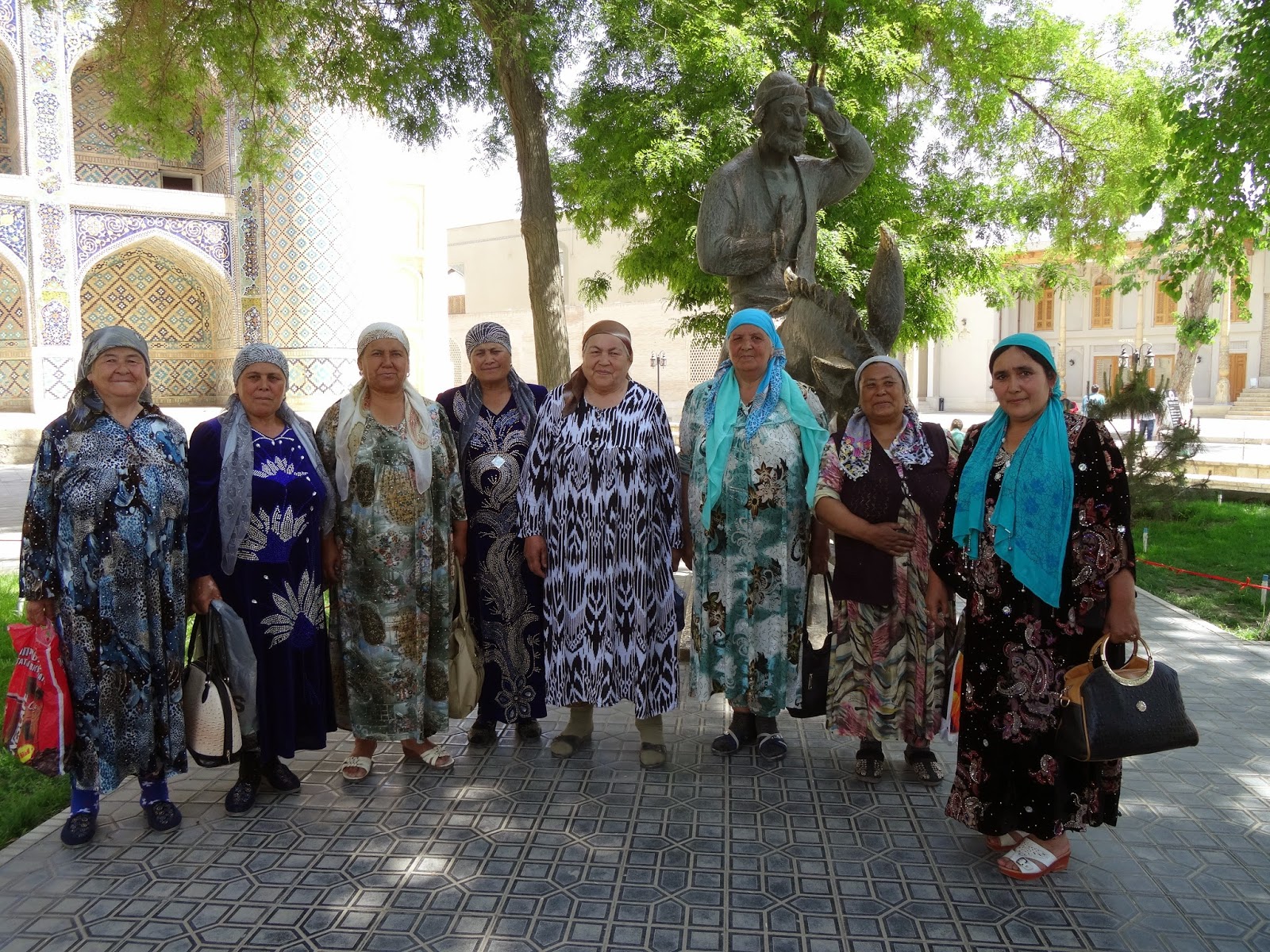
Walking back through old town to our hotel we stopped at a puppet maker shop, the central square/pool, and a synagog with a 400 year old Torah.  An old woman was asked to vacate her house so that the central pool could be put in but she refused.  Eventually she was persuaded but her stipulation was that a synagog be built in the courtyard of one of the nearby homes.  In the square there is a bronze statue of the Uzbeke version of Don Quixote.  While there we encountered a young family and engaged in a dialogue without any common language.  We took pictures of them and they of us.  Afterwards they invited us home for dinner—it would have been fun.  The same statue drew the attention of 7 or 8 Uzbeke older women.  Sue asked our guide to tell them she liked their dresses—once again long and sparkly with head scarves to match.  One woman asked how old Sue was and her reply of 67 drew high fives, a strong strong handshake, a bear hug and a kiss on each cheek—sisters of the same age.  Lots of laughter and picture taking ensued. Many of the women in particular have lots of gold teeth. Not just this group but women in general. And scarfs are worn by most. Very colorful and tied at the back of the neck with varying knots. The knots and colors depict the region they are from.
The material indicates their status. Their dress in long robe like coats over tights or pants is colorful and bright.  

Today we wandered yet again and visited madrasas, mosques, the oldest tower in town, the Poi Kalon (minaret with big feet), and a mausoleum that survived the destruction of Genghis Khan.  The blue domes, and sandy colored brick buildings with carved and painted plaster around the doors/arches and carved wood columns define this ancient city.  People are friendly and are interested in engaging with us, sharing their well wishes and stories of their activities, crafts, or age.  That seems to be one of the topics that comes up early in conversation.

Tonight we are doing to a local musical/dance show and then to dinner at the home of a local man who lives near the center of town.  We leave tomorrow to begin our drive to Samarkand.